Offshore wind on West Coast poses unique challenge: Depth
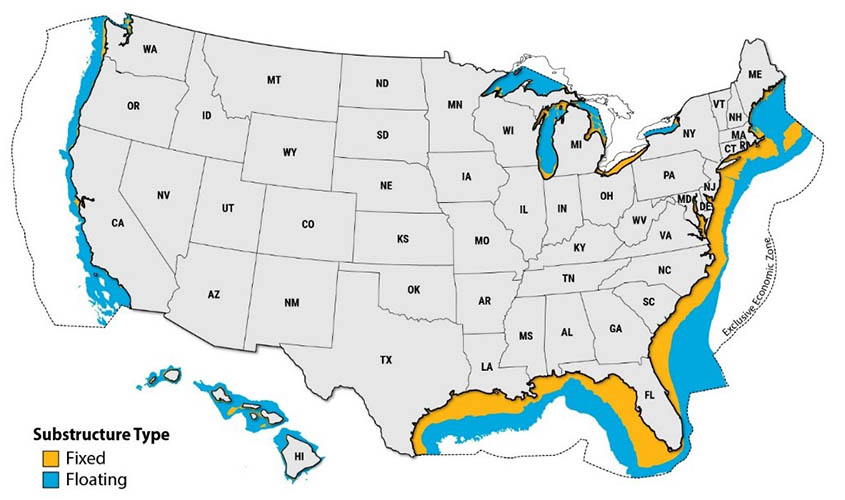
Source: National Renewable Energy Laboratory
Different Coasts: On the East Coast, the continental shelf remains fairly shallow as it extends eastward before dropping off into the depths of the Atlantic Ocean. This allows the construction of fixed offshore wind turbines that can be directly mounted to the seabed. This is not the case on the West Coast. The continental shelf drops off almost immediately from the coastline into the depths of the Pacific Ocean. This means offshore wind turbines would need to float and be mounted to the seabed using mooring anchors to keep it in place.
Fixed vs. Floating Platforms: While the use of fixed offshore wind turbines has been around since the 1990s, floating platforms are newer tech. Almost every offshore wind farm in the world utilizes fixed turbine platforms to generate energy. Only a handful of floating offshore wind farms currently exist: two in Scotland and one each in Portugal and Norway.
Floating Challenges: Floating wind platforms face different challenges compared to fixed versions: Installation and maintenance costs could be higher, harsh weather and disasters, such as tsunamis, could impact operations or even damage platforms, and the logistics involved to assemble and install turbines are complex and time-consuming.
- Interactive: John Osborn D'Agostino, CalMatters
- Source: National Renewable Energy Laboratory